Over the past decades, Dutch Design Week (DDW) has established itself as one of Europe‘s most important testing grounds for forward-looking design visions. As an annual event in Eindhoven, it brings together designers, researchers, companies, and the public to present and discuss innovative approaches, radical ideas, and sustainable solutions. Its relevance lies not only in the sheer diversity of the projects on display, but above all in its role as a catalyst for social, ecological, and technological change.
Here, questions are asked that go beyond the boundaries of traditional design disciplines: How can design contribute to a circular economy? Which materials and processes enable a post-fossil future? How can local production be combined with global challenges? The answers can be seen not only in individual projects, but also in a space for discourse where failure, learning, and rethinking are explicitly encouraged.
This year‘s DDW Mission in Eindhoven focused primarily on sustainability, material innovation, and participatory processes. DDW is thus responding to pressing challenges such as climate change, resource scarcity, and social inequality—all from the perspective of designers. At a time when Europe is looking for ways to strengthen ecological and social resilience, DDW serves as a laboratory for possible futures. For designers, companies, and institutions, DDW also serves as a seismograph for upcoming trends. The projects and discourses presented here not only influence the design industry itself, but also look beyond the horizon. I would like to highlight six thematic complexes that particularly caught my attention. This is a subjective view based on a few projects. Above all, however, it should offer us as graphic designers opportunities to apply our skills to communicating these thematic complexes and use our knowledge to create a stronger impact.
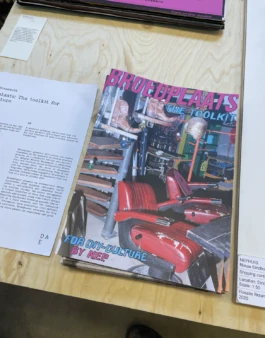
DIY (Do It Yourself) stands for a democratized design culture enabled by digital tools and open knowledge sources. At Dutch Design Week, it was particularly relevant to see how the DIY spirit can be applied to sustainability and local value creation. Graphic design can act as a mediator here, for example, by visually presenting instructions, open-source designs, and participatory processes.
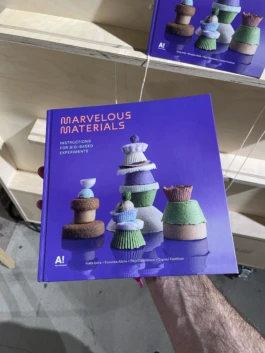
Marvelous Materials
Workshops on materials research in the home environment.
This project by Aalto University enabled participants to experiment with everyday materials at home. Simple instructions were provided to transform materials such as alginate (from algae), coffee grounds, and eggshells into new materials. The aim was to encourage creativity in dealing with waste and to raise awareness of material properties.

The term “nature” here refers primarily to a return to natural materials. The “Grow your own shoe soles” project demonstrates how design can interact with biological systems. As graphic designers, we can either immerse ourselves in communicating these topics or focus our own attention on material cycles (e.g., paper and packaging) in our industry.
Grow your own shoe soles
Instructions for growing biodegradable shoe soles.
This project enables users to grow their own biodegradable shoe soles from fungal mycelium. A kit containing mycelium spores and a mold is delivered; after two weeks of growth, the sole is ready. The concept combines DIY with sustainable fashion and resource consumption. It enables users to conserve materials and produce their own goods at home. More information here.

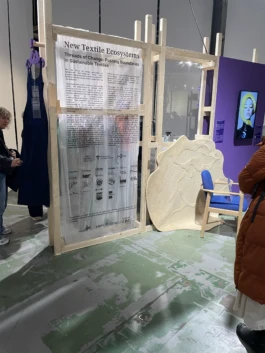
As can be seen in the previous example, the topic of nature is closely linked to materials research. It is a key area for sustainable design and is also being addressed at the institutional level. A consortium of Dutch universities and companies presented the current state of research under the title “New Textile Ecosystems,” featuring innovative materials such as mycelium, algae, and recycled textiles. As graphic designers, we can make these developments accessible through informative and appealing presentations.
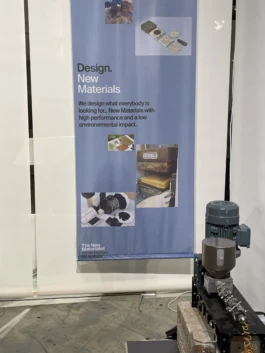
New Materials
Presentation of innovative, sustainable materials.
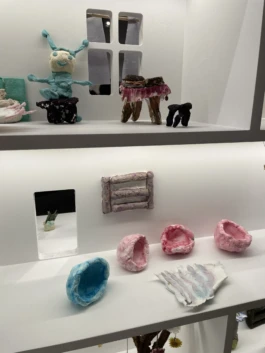
The “New Materials” exhibition presented a selection of innovative materials made from waste, algae, or bacteria. From compostable ‘leather’ made from mushrooms to “stone” made from recycled glass. More information from “New Textile Ecosystems” webpage.
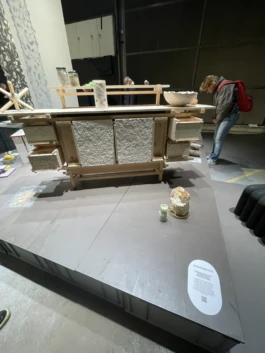
Temporary Constructions
Research into mycelium as a sustainable material in combination with 3D printing and biological decomposition.
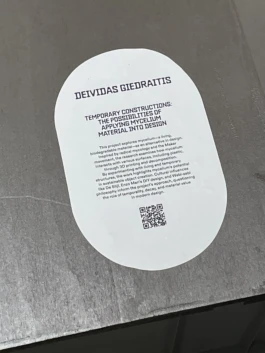
In “Temporary Constructions”, Deividas Giedraitis explores the potential applications of mycelium as a living, biodegradable material in design. The project combines mycelium with 3D printing technologies to create temporary structures that are compostable after use. Inspired by the Radical Mycology movement and DIY thinking, Giedraitis investigates how mycelium interacts with various surfaces, including plastics. Targeted decomposition processes create ephemeral objects that blur the boundaries between growth, use, and decay.
The attribute “experimental” runs through many of the works at DDW. Above all, it is about playfulness and a willingness to take risks in order to discover new solutions to familiar problems.
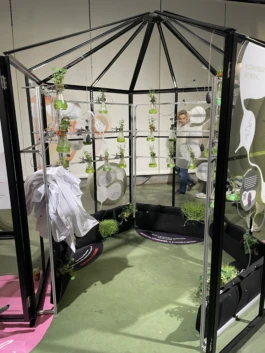
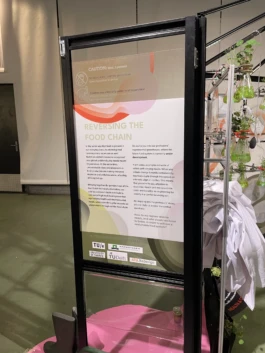
Reversing the Food-Chain
Reversing the food chain through design interventions, e.g., insect farming as a source of proteins.
This project reverses the traditional food chain by using waste products from the food industry as a resource for new protein sources. Breeding insect larvae on organic waste produces high-quality animal proteins, which in turn serve as animal feed or for human consumption.
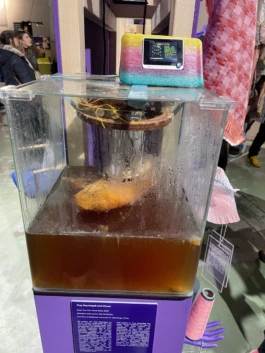
Laguna Lilipur
Experimental design of habitats incorporating natural ecosystems.
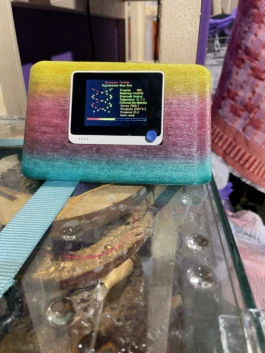
Laguna Lilipur is an experimental ecosystem design that combines natural and artificial elements to create a symbiotic habitat. The project explores how design can support the regeneration of wetlands while creating aesthetic and functional spaces. The integration of plants, microorganisms, and recycled materials creates dynamic landscapes that purify water, promote biodiversity, and can be used by humans.
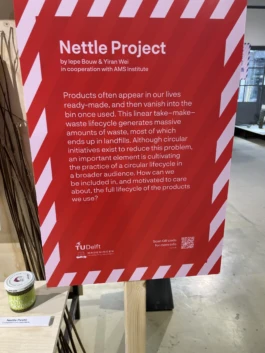
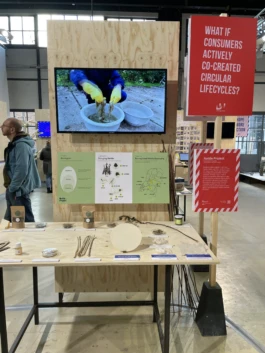
Recycling and upcycling are key strategies for a circular economy. Projects such as the Nettle Project demonstrate how waste materials can be transformed into new products. Graphic design can use intelligent campaigns to bring these processes to the attention of society at large, thereby helping to raise awareness.
Nettle Project
Using nettles as a sustainable textile fiber.
The Nettle Project is dedicated to rediscovering nettles as a sustainable textile fiber. Traditional processing techniques and modern weaving methods are used to create fabrics with cotton-like properties—but with significantly lower water and pesticide requirements.
Design approaches:
Slow fashion: Emphasis on durability and repairability.
Collaboration with artisans: preservation of traditional knowledge.
Minimalist aesthetics: focus on the natural beauty of the material.
Circular design aims to close material cycles. The topic has been an integral part of the design debate for several years now. DDW 2025 showed how design can contribute to the transition from a linear economy to a circular economy.
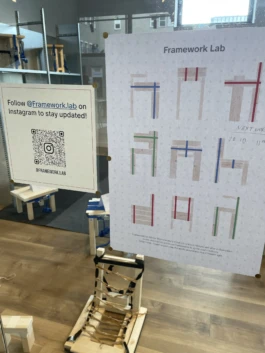
Modular & DIY (Framework Lab)
Development of modular, self-build furniture and structures.
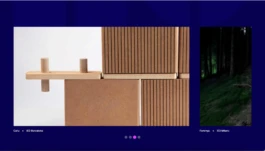
The „Framework Lab“ develops modular construction systems that can be assembled and disassembled without specialized tools. The designs are open source and allow users to design furniture or architecture according to their own needs. Standardized connections make it easy to replace or repair materials.
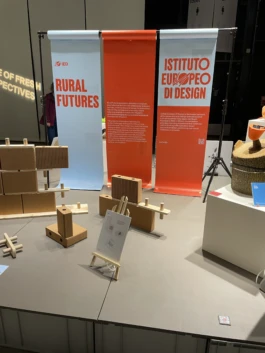
IED Istituto Europeo di Design
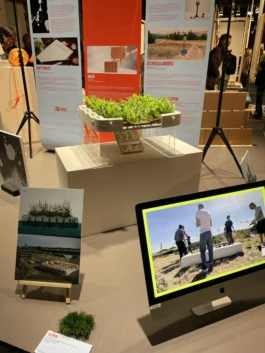
Rural FuturesInvestigation of rural future scenarios with a focus on localresources and communities.
“RURAL FUTURES” is an interdisciplinary project that positions rural areas as spaces for innovation in sustainable design. It investigates how local resources, traditional knowledge, and modern technologies can be used synergistically to create more resilient communities. The project presents scenarios in which design acts as a catalyst for social and ecological regeneration—for example, through the revitalization of traditional craft techniques and materials. It also clearly demonstrates the combination of cutting-edge technology and its potential application in people‘s everyday lives.

[18] copyright: https://app-api.ddw.nl/programme/ied-istituto-europeo-di-design-rural-futures [Screenshot]
[1]–[17] Credits: Michael Schmitz.
[18] Screenshot: https://app-api.ddw.nl/programme/ied-istituto-europeo-di-design-rural-futures, 12.11.25, 20:14.
Exhibition project exploring national narratives, borders, and public discourse at Dutch Design Week. → See project
Comprehensive publication that addresses radical changes communication designers are facing. → See project
Research project and publication on sustainable strategies for police service clothing. → See project