Solidarity in graphic design
Reading Time: 5 minutes
Topics: #Solidarity, #Community, #Activism, #Soliparty, #solidaristic design, #commons, #design, #co-design
Introduction
Solidarity isn’t a look, it’s a practice
Solidarity in graphic design is often misunderstood as an “activist aesthetic.” In reality, it’s less about style and more about relationships, power, and distribution: Who decides? Who benefits? Who carries the risks? And who gains access to information, services, and visibility?
Claryfying the term
In the course of the founding of Soliparty, a collective of designers, illustrators and photographers who offer their support free of charge to initiatives in civil society, this essay on thoughts about solidarity-based graphic design was created.
Solidarity vs. charity vs. activism
Solidarity implies shared stakes in the face of inequality — not simply “help from above.” In design, the difference often looks like this:
Charity: the designer decides what’s needed; recipients remain passive.
Solidarity: the designer shares decision-making power, listens, and builds together; affected people become agents.
Activism: can be solidaristic, but doesn’t have to be (e.g., when communities are instrumentalized or aestheticized).
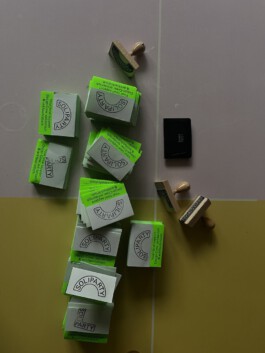
Infomaterial from the first round of printing stuff after the founding of Soliparty as a collective effort to provide design to antifascist actions in need
As a conceptual frame, the Design Justice Principles are useful (also available in other languages): they emphasize centering directly affected voices and prioritizing impact over intention. [1]

[2] Screenshot from www.designjustice.org, 11.01.2026, Licensed: CC BY-ND 4.0, Creative Commons
10 principles from Design Justice Network
The Design Justice Network had been found in 2016. It was initiated from Nina Bianchi, Una Lee, Andy Gunn, Victoria Barnett, Ben Leon in 2014 as the Future Design Lab at the Allied Media conference formulates the following principles:
Principle 1: We use design to sustain, heal, and empower our communities, as well as to seek liberation from exploitative and oppressive systems.
Principle 2: We center the voices of those who are directly impacted by the outcomes of the design process.
Principle 3: We prioritize design’s impact on the community over the intentions of the designer.
Principle 4: We view change as emergent from an accountable, accessible, and collaborative process, rather than as a point at the end of a process.*
Principle 5: We see the role of the designer as a facilitator rather than an expert.
Principle 6: We believe that everyone is an expert based on their own lived experience, and that we all have unique and brilliant contributions to bring to a design process.
Principle 7: We share design knowledge and tools with our communities.
Principle 8: We work towards sustainable, community-led and -controlled outcomes.
Principle 9: We work towards non-exploitative solutions that reconnect us to the earth and to each other.
Principle 10: Before seeking new design solutions, we look for what is already working at the community level. We honor and uplift traditional, indigenous, and local knowledge and practices.
* This principle was inspired by and adapted from https://www.alliedmedia.org/about/network-principles.
Five take-aways from Soliparty for solidaristic design
1. Share power: co-design and shared authorship
Solidarity means not only “visualizing” but opening decision spaces (briefing, language, imagery, channels, approvals). This includes questions of credit, usage rights, ownership of assets, and real participation.
2. Create access: accessibility as a baseline
If communication excludes people, it undermines solidarity. Accessibility isn’t an “extra” — it’s foundational: contrast, legibility, clear hierarchy, alt text, captions, plain language, multilingual communication. In Europe this is also regulated in many contexts: the EU Web Accessibility Directive requires accessible public-sector websites/apps. In Germany, this is specified through instruments such as BITV 2.0. As international guidance, WCAG 2.2 is commonly used. [3]
3. Share resources: commons instead of one-off campaigns
Solidaristic design builds things others can reuse: open templates, toolkits, translation packs, print-ready files, design systems, licensable illustrations, documentation.
4. Produce fairly: solidarity begins in the working relationship
Solidarity is not credible if it relies on speculative labor, precarity, or “exposure instead of fees.” It could also means fair budgets, clear timelines, anti-pitch norms, transparent roles, and protection for freelancers and juniors.
In the project „Soliparty“ it especially means that everyone has the chance of initiating, taking responsibility and is working in terms of their own agenda.
5. Safety & responsibility: consent, security, data
In vulnerable contexts (flight/migration, protest or violence), “more visibility” isn’t automatically good. Solidaristic design considers consent, anonymization, image rights, risks of repression, and digital attack surfaces. So solidarity-design also means to protect vulnearable groups in the documentation. [4]

[4] Example of a photograph that can protect the identity of visitors at the 1st Christopher Street Day in Grevesmühlen in rural East Germany. Constant threats from aggressive right-wing circles make it necessary to consider such aspects in the documentation.
Credits: Thomas Pirot for Soliparty
Practical aspects of solidaristic design
But how could it look like in a practice? What practical aspects do we need to take into account if we think about a solidaristic design project?
Co-design formats:
co-defining the problem, feedback loops, if possible: “community review” before publishing
Multi-channel distribution:
social packs + printable posters + local partners + low-threshold locations
Accessible communication building blocks:
contrast/typography checks, alt text, plain language, clear iconography [5]

[5] Multilingual website for “Würzburg Solidarisch” to reduce language barriers online
Credits: Katharina Koch, Nora Prinz, Michael Schmitz for Soliparty
Tooling & standardization:
component libraries, guidelines, open files, translation workflows, open technology if possible
Outcome measurement:
not just reach — use, comprehension, actual access, feedback, empowerment
As a starting-point for an open discussion there should be clarifyed that all these aspects for solidarity in design are a try-out to define it. There is no final definition possible. It should be clear and desirable that solidarity in design is an ongoing process of dialogue among all participants within a project. The attempt to capture some aspects of our work with the Soliparty can only be seen as a starting point.
– January 2026
Practical checklist
“Is this solidaristic?”
→ Who defines the problem – you or affected people?
→ Who decides on language, images, tone, and channels?
→ Who gets credit and rights to the assets?
→ Who is excluded by language/format choices?
→ Is accessibility planned from the start (not added later)?
→ How are risks (visibility, repression, stigma) minimized?
→ Are resources made shareable (templates, docs, licensing)?
→ Is labor fairly paid – or transparently organized as pro bono?
→ How is feedback collected – and what happens to it?
→ How do you measure impact beyond reach?
Sources
[1] https://designjustice.org/german, 11.01.2026, 16:20.
[2] https://designjustice.org, 11.01.2026, 17:30.
[3] https://www.w3.org/TR/WCAG22/, 09.01.2026, 12:14.
[4] Screenshot: https://www.instagram.com/p/DOlXAq1jNhN/?img_index=1, 11.01.2026, 15:45.
[5] Screenshot: https://www.wuerzburg-solidarisch.de/en/support/, 11.01.2026, 14:45.
Related Projects
Soliparty (2025)
Collective design initiative empowering antifascist groups. → See project
Nicht Neutral (2025)
A visual handbook empowering civil society and associations to defend democracy. → See project
Seebrücke (2018)
Visual communication for the civil society movement advocating for safe escape routes and solidarity with refugees. → See project